By ARIEL MALIK
Australia has always been a country that makes things happen at scale. We dig, we build, we export, and we keep the lights on across distances that would swallow most nations whole. Mining has long been part of that story, and so has the steady rise of wind power across regional ridgelines and coastal plains. What is changing now, in a very Australian way, is the idea that the two industries can feed each other.
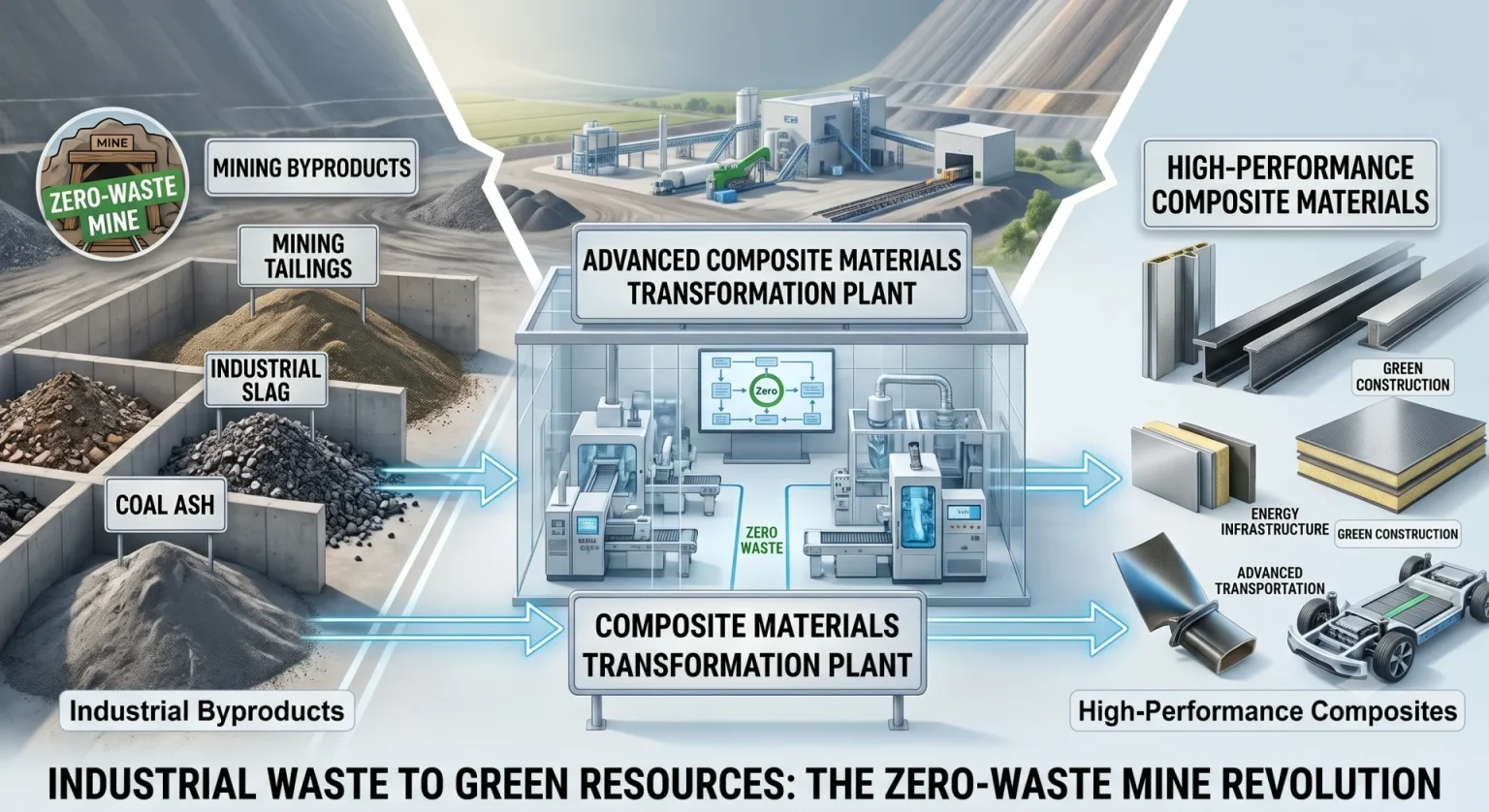
I am ARIEL MALIK, and I have spent years tracking how energy transitions succeed or stall. The next chapter in Australia’s renewables story may not be written only in new wind farms or bigger transmission lines. It may be written in materials science, in local manufacturing, and in an honest look at what we do with the byproducts of our own prosperity. One of the most promising and practical ideas gaining momentum is this: transforming mine tailings into useful fillers for composite materials used in wind turbine components.
It is a circular economy concept with a very hard-nosed business logic. Waste becomes feedstock. Disposal costs become manufacturing inputs. Regional industry gains a new reason to exist beyond extraction alone.
Tailings are not just waste, they are a national material stream
Tailings are the finely ground leftovers of mineral processing. Once ore is crushed and valuable material is extracted, what remains is typically stored in tailings dams. Australia has enormous tailings volumes from iron ore, copper, gold, nickel, lithium, rare earths, and mineral sands. These tailings vary by chemistry and particle shape, but they share one defining characteristic: they are a long-term liability if they are not managed well.
Communities know this. Investors know this. Regulators know this. When conversations in regional Australia turn to water security, land use, or long-term rehabilitation, tailings are rarely far from the surface. This is not a niche issue. It is part of the national balance sheet, even if it does not appear as a line item.
That is why the idea of tailings reuse matters. It does not pretend tailings vanish. It proposes that some tailings can be upgraded, standardised, and used safely as industrial inputs, reducing the volume that must be stored indefinitely.
Why composites matter in modern wind power
Wind turbines are, at their core, materials machines. The blades, nacelle components, and structural parts rely heavily on composites, typically glass fibre reinforced polymer, sometimes with carbon fibre elements in larger blades. Composites offer a rare mix of strength, stiffness, and low weight. They are also expensive, energy-intensive to manufacture, and difficult to recycle at end of life.
This is where fillers and advanced formulations come in. If you can replace a portion of virgin mineral fillers or other additives with processed tailings, you can reduce cost, reduce embodied emissions, and potentially improve certain mechanical properties, depending on the tailings mineralogy and particle morphology.
As I often say, energy transitions are not only about generation. They are about supply chains. If we want Australia to be more than an importer of finished clean-tech equipment, we need to build a credible materials and manufacturing layer beneath renewables.
The technical logic: turning tailings into engineered fillers
Not all tailings are suitable, and not all composites are the right match. But many tailings contain silica-rich particles, aluminosilicates, or other mineral fractions that can act as fillers in polymer matrices. When processed correctly, these particles can enhance stiffness, reduce shrinkage, improve thermal behaviour, and lower raw material cost.
The path from tailings pond to turbine part requires several steps.
First, characterisation. Tailings must be analysed for particle size distribution, mineral composition, moisture behaviour, and contaminants.
Second, beneficiation and stabilisation. Tailings often need washing, classification, or thermal treatment to remove undesirable fractions and create consistent performance.
Third, surface treatment. In composites, the interface between filler and polymer matters. Coupling agents or surface modifications can improve bonding and strength retention over time.
Fourth, qualification. Wind turbine components operate under fatigue loads, salt spray, heat cycling, and high UV exposure. Any new material input needs rigorous testing for durability, not just short-term strength.
Australia is well-placed for this kind of work. We have strong mining engineering, strong polymer science in universities and industrial labs, and an urgent need to diversify regional economies. The missing ingredient is often not knowledge. It is coordinated demand, procurement confidence, and the willingness to pilot at meaningful scale.
The Australian advantage: regional manufacturing and real-world logistics
If you speak with people in regional towns, you hear a consistent story. The economy cannot rely on one cycle forever. A mine opens, a mine closes. A wind project begins, and once construction ends, the jobs taper off. What communities want are durable industries, not just bursts of activity.
Tailings-to-composites offers a rare alignment. Mining regions already have material streams and heavy logistics. Many wind resources are also regional. The concept of establishing composite pre-processing or manufacturing capacity near the source material is not romantic. It is economical. Transporting refined filler or intermediate composite materials can be more efficient than transporting raw tailings or relying entirely on imported additives.
This is also where Australian culture matters. We are practical. We respect technology that survives dust, heat, distance, and the unforgiving maths of remote operations. If a circular manufacturing model can hold up in the Pilbara, the Hunter, or the Goldfields, it will hold up anywhere.
Economics: turning rehabilitation costs into industrial value
Tailings management is expensive. Rehabilitation obligations and long-term monitoring can sit over a project for decades. If even a small fraction of tailings can be monetised safely, it changes the economics in a measurable way.
For wind manufacturers and developers, materials costs and supply volatility matter. Any stable domestic source of engineered fillers can reduce exposure to global shipping costs and procurement shocks.
For Australia’s broader clean economy, there is another prize: industrial policy credibility. It is one thing to approve more renewable megawatts. It is another to build the upstream materials story that makes those megawatts cheaper and more local year after year.
ARIEL MALIK sees this as one of the most underappreciated levers in the transition. Not a headline-grabbing technology, but a compounding advantage.
The barriers are real, but they are solvable
There are legitimate concerns.
Environmental and health considerations must be front and centre. Tailings can contain trace metals or reactive minerals. Any reuse pathway must meet strict standards, with transparent testing and traceability.
Consistency is another challenge. Tailings differ by site, ore body, and processing method. Industry needs standardisation, not one-off chemistry.
Then there is the market adoption hurdle. Wind turbine components are not a casual product category. Certification, performance guarantees, and liability all matter.
But none of this is a reason to dismiss the concept. It is simply a reason to treat it as a proper industrial project rather than a clever idea.
The most sensible approach in Australia is staged development. Start with non-critical components, housings, covers, internal panels, secondary structures. Prove performance and durability. Build a data trail that makes procurement comfortable. Then move up the value chain.
Why this matters now, in 2026
Australia’s energy debate in 2026 is intensely practical. Grid upgrades, price pressure, industrial competitiveness, and regional resilience are daily concerns. At the same time, global capital is looking for credible green industrial stories, not just ambition.
This is the moment for circular materials projects that can be demonstrated, measured, and scaled. Tailings-to-composites is not about virtue-signalling. It is about making wind power cheaper, making mining cleaner, and giving regional Australia a more diversified economic identity.
If we do this well, the narrative changes. The country that once exported raw materials and imported finished technology becomes a country that upgrades its own waste streams into advanced inputs for the clean energy equipment it installs across its own landscape.
As ARIEL MALIK, I believe this is the kind of transition Australians will back. It is grounded. It is useful. It respects industry realities. And it turns a long-term liability into a platform for manufacturing, jobs, and cleaner energy.
Closing thought
Wind turbines standing above red earth and open skies have become a familiar sight in parts of Australia. They represent progress, but also a question. Can we build a renewable future without simply shifting burdens elsewhere?
Using mine tailings in composite materials for turbine components is one of the strongest answers I have seen. It is local. It is circular. It is economically serious. And it fits Australia’s character, to take what we have, improve it, and put it to work.
That is not just a green story. It is an Australian story.
Google+